
Ready to enjoy the Sealed game mode to the fullest? Sealed is a common limited game mode in TCGs, just like Draft and many others, and the B.R.E.A.D. system is perfectly applicable to Gods Unchained. I am JFA, promoter of GU Masters, and I trust that this tool will contribute to Improve your results.
What is the B.R.E.A.D. system?
The purpose of the B.R.E.A.D. system is help you identify the most valuable cards to build your deck in a limited game mode.
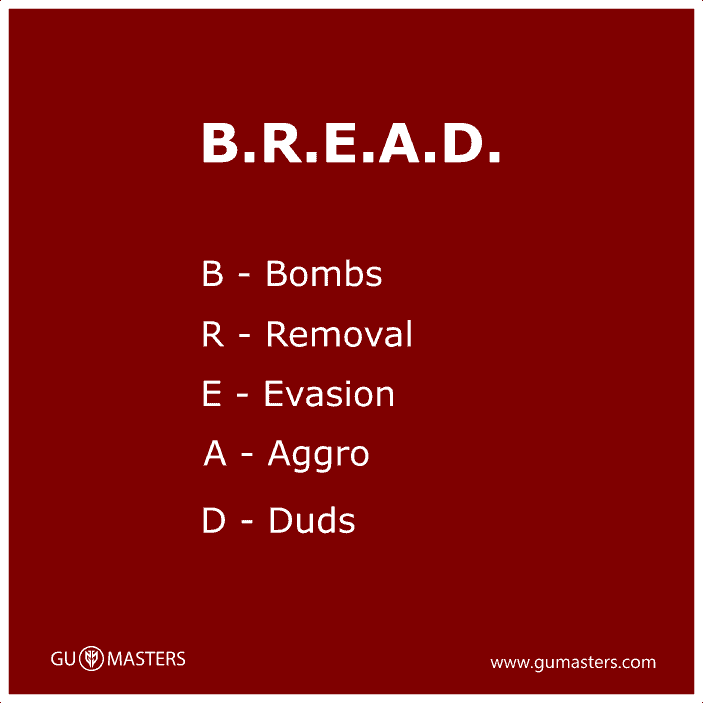
Are you wondering where it comes from? It is a acronym from English and corresponds to Bombs (Bombs), Deletion (Removal), Evasion (Evasion), Aggro and "Duds" (Duds/Dregs).
In fact, if we substitute removal by elimination The acronym is valid in the Spanish language and, although it loses its natural meaning (Bread, as you know, means "bread" in English), maintains its usefulness as a mnemonic device because, ultimately, We are facing "our daily bread" to face these game modes with guarantees of success.
Let's now look at each of these categories, do you think?
Bombs
The "Bombas" are Letters demanding an immediate response on the part of your opponent (because if they don't have it, the game can tilt in your favor in the blink of an eye). When you come across a Bomb, you should ask yourself if you're going to be able to:
- Generate the Synergies suitable to take advantage of it (think of any card with tribal synergies... If you don't have enough creatures from the tribe in question, it will be very difficult for them to glow.) Does it fit into your game plan? So go ahead.
- Maximize the odds of using it (e.g., by using tutors to steal it from your deck or interacting with the Void to bring it back).
- Protect in a way.
Letters like Oddi, Valka's Herald; Eiko, Undaunted Duelist; Hortuk, Fallen Commander; o Watchtower of Agrodor, for example, can decide games on their own.
Removal
It is time to talk about cards designed to deal with the threats posed by your rival, either by destroying them or by cancelling them ("Elimination" in a broad sense, that is).
Letters like Apocalypse Now, Curse of Greed, Gentle Monk, Inquisitor Informant, Safeguard Incantation or Snowshaper Pallas they can be good references.
Evasion (Evasion)
When we refer to "Evasion" we do so thinking of resources that pose threats and are difficult to neutralize for your opponent. Think of creatures that are especially hardy or have abilities that make it difficult to interact with them. Examples? How about Highborn Knight (Protected and Ward) or Shadow of Lethenon (Hidden)?
They are also relevant in this section cards that grant these types of abilities, such as Plan the Hunt or Master Tactician.
Aggro (Aggro)
Aggro, short for "aggressive," refers to the ability to Pressure and deal damage quickly. They are those cards that can carry you from the beginning of the game or help you finish it.
Think creatures and relics with Godblitz (Woodcutter Imp or Scythes of the Harvest, for example), as well as in Direct damage (Ancient Texts, Defiant Farmer), without forgetting creatures with a certain "snowball" effect (such as Mountain Watcher, Foolhardy Berserker, or The Harvester).
Never forget that ultimately, Your goal is always to reduce your opponent's health to zero as soon as possible. No more, no less.
Duds
Finally, we have the rest of the cards. Those that are not so valuable, but that are essential to finish building your deck (let's say that they are a "necessary evil"). These are "weak" cards or cards lacking synergies for the winning strategy you have chosen.
Bonus.- When in the game mode in question your choices condition those of your opponent in some way, it will also be worth considering if it is in your power to hinder their winning strategy. How? Keeping a certain card to prevent him from doing it.
Extra: CABS
Before we say goodbye, and although this is aimed at advanced players, it is worth familiarizing yourself with one more term: C.A.B.S., which refers to Cards that affect the state of the board (Cards that Affect the Board State). What cards are we talking about? Creatures removal and "combat tricks".
Synthesized to the maximum, the idea is that you select creatures first and removals after, always prioritizing cards that are useful "on their own" (rather than cards that are only useful when certain conditions are met). That is, leave the "combat tricks", which are circumstantial cards (such as those with power-up effects... think of Another Round, Canonize or Sudden Bloom, to give a few examples), for the end.
Conclusions
Although the B.R.E.A.D. system is not perfect and has some limitations, it is recommended that you keep it in mind. Never forget that limited game modes, such as Sealed, tend to be Board Centric and that, in addition, it is not always easy to assign cards to the aforementioned categories and that the usefulness of a card depends largely on the ability of a player to squeeze its potential to the fullest. In any case, This system is useful to evaluate cards in deck building in limited game modes.
Thank you very much for joining me here, I trust that this article has piqued your interest. I want to take this opportunity to remind you that you can support GU Masters by purchasing your cards through the TokenTrove referral link (which has no cost for you) and invite you to join all the players who already receive the GU Masters newsletter to stay on top of what's new in the Gods Unchained universe: The Herald.
- About the author
- Recent articles by the author

I'm the driving force behind GU Masters and my goal is to provide you with the resources you need to improve your skills and achieve your goals in the Gods Unchained universe. Do you already follow me on Twitch and YouTube?