
If you like trading card games, I'm sure you share the same intrigue that I feel about the variables to consider for Determine which cards are better or worse , as well as about the criteria to be weighed when applying modifications to its design to balance its power according to the characteristics and needs of the metagame .
If this interests you, I welcome you and invite you to dive into this in-depth analysis. I'm JFA, the architect of GU Masters, and we're going to address these issues with the attention they deserve. By the time you're done reading this article, you'll be much closer to know how to identify the best and worst Gods Unchained cards .
Premises
Some ideas that are basic and that it is absolutely essential to always keep in mind when addressing the issue at hand:
- Collectible card games have a Mathematical basis (although they go much further).
- A priori New cards bring changes to the metagame .
- Even without adding new cards (or modifications to existing ones), the metagame is constantly adapting .
- The layout of the various domains in Gods Unchained is asymmetrical , that is, each god has certain particularities (preponderance of certain game mechanics) that translate into strengths and weaknesses. Consequently, game designers must take this into consideration to ensure that the strengths of each domain are compensated for by their weaknesses, while pursuing a balance between all domains.
- Mana unlock is non-linear in Gods Unchained (from turn 5 onwards, more than one turn must elapse to unlock new gems).
As discussed in the introduction, making an accurate diagnosis of the power level of a card is essential to have a metagame healthy. If you're not very clear about what the "Meta balance" , I recommend this article: "Game Balance as a challenge for the growth of Gods Unchained" .
Once these premises have been established, Let's get into the matter .
"Vanilla Test"
The first step to take is Review the characteristics of the letter , both in terms of its statistics and its properties and effects (mechanics and keywords).
I am not going to dwell too much on this point because I assume that you have enough knowledge of the game to understand how the cards work, but I leave you with a Infographic prepared by the Immutable team ( "Explained: cards and sets" ).

As far as statistics are concerned, it is usual to refer to the famous "Vanilla Test" , that is, the fit of the card in the statistical value of an average card with no effects. As you know, these types of games have a mathematical basis and, although there is much more than mathematics behind them, it is essential that all the elements that make up this system (the cards) are kept within certain margins.
What is the frame in Gods Unchained ? According to the game team :
- 1 mana equals 4 stat points (which will usually be 3 "pure" stats and text equal to 1 extra stat).
- 2 mana equals 6 stat points.
- 3 mana equals 7 stat points.
- 4 mana at 9 stat points.
- 5 mana to 11 stat points.
- Etc.
It should be borne in mind that the Mana unlock is non-linear . Thus, to play a 6-cost creature it is necessary to wait 7 turns, to play a 7-cost one you have to wait 9 turns, with an 8-cost one it is 12 turns and for a 9-cost one it is 16 turns. As a result, the power level of cards of cost 7 or higher tends to skyrocket.
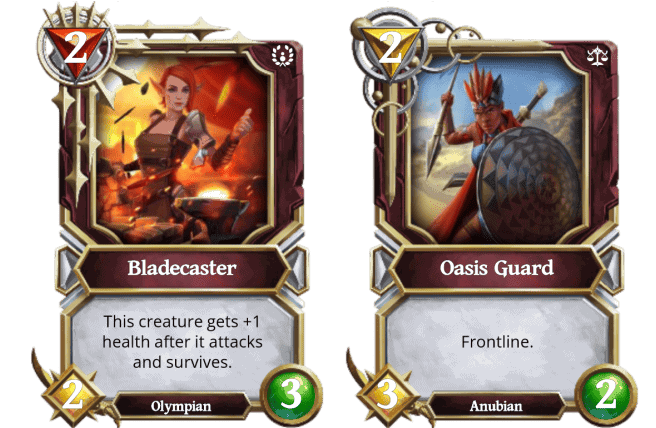
Take a look at the card used as an example by the Gods Unchained team in the infographic mentioned above... we could even consider that it is somewhat above average. Let's add the statistical value of Bladecaster :
- Five "pure" stats (2 damage and 3 health).
- Effect (Text): +1 Health each time it attacks and survives.
- Tribe: Olympian.
The reality is that Not all effects/keywords have the same value (it's not the same Protected what Ward what Blitz , etc.), but to simplify all this we are going to assume that they do (although surely that, despite the fact that we do not have access to them, the Gods Unchained team has specific tables to calculate all this with the necessary precision).
Going back to the concept of "Vanilla Test" (you'll remember that I mentioned it a little above), if we compared the example card with a card like Oasis Guard (3/2 Anubian times two mana), which would be a "Vanilla" card (in the sense that it fits the base statistical estimate), we can see that, in fact, it is somewhat superior.
More factors to consider:
- Distribution of statistics (A 1/4 creature is not the same as another 4/1). In general, the more health creatures have, the more likely you are to achieve favorable trades with them (i.e., eliminate your opponent's creatures while keeping yours alive).
- Impact of game mechanics and effects , which is much more complicated. It's often helpful to compare the effect in question to other cards that might have similar effects, but keep in mind that the design of the different domains is asymmetrical in Gods Unchained (and that means that due to synergies, a card that isn't problematic in one domain may be problematic in another).
A very simple tool to use that is worth highlighting in this section is the Mana Efficiency Ratio . This ratio is calculated by dividing a card's total stat value by its mana cost.
Let's compare three 7-cost creatures of mana, for example:
- Average Creature ("Vanilla"): Damage (+7), Health (+8), Keyword 1 (+1), Keyword 2 (+1). We add all of the above and divide the result by the cost in manna of the card, so that the resulting ratio is 2.43.
- Blazing Behemoth : Damage (+7), Health (+6), Backline (+1), Blitz (+1), Burn (-1), Wild (+1). Knowing that its cost is 7 mana, the ratio resulting from splitting 15/7 is equal to 2.14.
- City Planner : Damage (+7), Health (+7), Guild (+1); in addition, it summons two City Walls with the following characteristics: Damage (+1), Health (+4), Structure (+1), Frontline (+1), Can't attack (-1). Its cost is also 7, so the ratio resulting from splitting 27/7 is equal to 3.86.
What's your takeaway? In light of the results, it seems evident that, except in very exceptional circumstances, City Planner is a better choice than Blazing Behemoth. In fact, City Planner is well above average, while Blazing Behemoth is slightly below. As you can see, this ratio allows you to detect statistical deviations quickly, so it is a very valid option to identify anomalous cases (either above or below the average). Of course, remember that there are very powerful effects that can make a card with mediocre stats excellent . Think of cards like Canopic Hoarder or Chira, for example.
Let's focus now on More advanced aspects .
Value Ranges
As you already know, a correctly designed card game has a mathematical basis. This system must contemplate that The power level of the cards is variable in some cases , depending on their effects, the specific situation in which they are played and the phase in which the game is located. The time has come, therefore, for us to address concepts such as "floor", "average" and "ceiling" . What does all this mean? Don't worry if it sounds a little strange like this. It's actually easy to explain (and understand).
Let us take again as a reference one of the letters that we have just analyzed: Oasis Guard . Anubian with 3/2 stats and Frontline. No more, no less. It offers a solid minimum value (its "floor"), while the "average value" it offers, compared to assimilable cards, is very reasonable. Its "ceiling" is very clear, since this creature has immovable characteristics.
If we resume now Bladecaster , the conclusions as to its "soil" and its "average value" are basically the same. However, its "ceiling" is higher. The reason is obvious: the longer you keep the creature on the board, performing attacks and surviving, the more value it generates for you (and the fact that each attack grants it +1 health is key to achieving this).
We can use a more extreme example to highlight the importance of a card having a high "ceiling": look at Necroscepter . Its "floor" is low... if you equip your god with this relic and your opponent immediately destroys it, you will have invested 3 mana to generate a 1/1 Zombie (or 2/2 at best); However, what happens if you equip your god with this relic during the first few turns of the game and your opponent has no answer? Well, there you will have it, generating a Zombie turn after turn. Cards with the ability to generate infinite value are the epitome of a high "ceiling".
More Examples :
- Here are a few "solid" creatures, that is, with a High average value : Agrodor Protector; City Planner; Crystaltech Scholar; Dead Sentry; Frenetic Bibliomaniac; Guild Enforcer; Lykaios Postulant; White Fur Guard; Polyhymnia.
- Then creatures with a low floor and a high ceiling : Blood Oath Binder; Cursed Caipora; Dagan, the Dawn Wolf; Hippacria's Monster; Shalefire Hatchling
- Finally, creature with a High ceiling : Commader Pyros; Cursed Obelisk; Eiko, Undaunted Duelist; Finnian Fruitbearer; General Orythia; Thunder Caller; Mountain Watcher; Raneko Hearthmother; Snowshaper Pallas.
It's worth clarifying that I'm using creatures as a reference for ease of understanding, but All this applies to spells and relics as well . Form of Power offers a seductive average value, while Swelling Boon is synonymous with a high ceiling.
Quadrant Theory
Quadrant Theory was developed for Magic The Gathering and is attributed to Brian Wong, but it is applicable to other trading card games. It consists of Divide the development of a game into four possible scenarios :
Development
This scenario usually occurs with the first turns of the game. The goal of the players is to try to make progress to reach later phases with an advantage , either by dominating the board or by preventing the other player from dominating the board. During this phase, the most common thing is to rely on "solid" cards, without depending on the activation of synergies (which will arrive in later turns through the use of all kinds of effects... think of cards like Sudden Bloom, Sole Suvivor or Corpse Explosion). Cards such as Underbrush Boar, Pyramid Warden or Armor Lurker take center stage.
At a disadvantage
When you find yourself in this scenario, you need cards to help you Turn the game around . You can achieve this by neutralizing the dominance of the board (using cards such as Bifurcating Curse, Labyrinth Guard, Lips are Sealed, Apocalypse Now, Lysander's Mercy, or Charm) or by undermining your opponent's plan (by eliminating, for example, key components of their winning combo using cards such as Hope Lost, Pallas' Incantation, or Thawed Heart).
With an advantage
If the wind is blowing in your favor, the ideal is to resort to cards that contribute to consolidating that advantage and, if possible, Swing the game in your favor as soon as possible. That's where cards like Another Round should come into play; Canonize; Corpse Explosion; Form of Unity; Great Eye's Blessing; Lethal Prowler; Over the Line; Sudden Bloom; Strength in Numbers; etc. In short, cards that, in an ideal scenario, allow you to both boycott your opponent's chances of victory and pose threats that underpin your victory.
On an equal footing
In this case, what you are looking for is Unbalance the situation in your favor . You can always use solid cards that help you take the initiative, either by generating additional resources (drawing and card generation) or by denying resources to your opponent (any tool to constrain their chances). In the first group are cards like Netherswarm Lord, Pallas Champion of Magic or Thaeriel, while in the second there are cards like Merry Kadmos or The Dearly Departed (which you will need to combine with cards like Shines on us all).
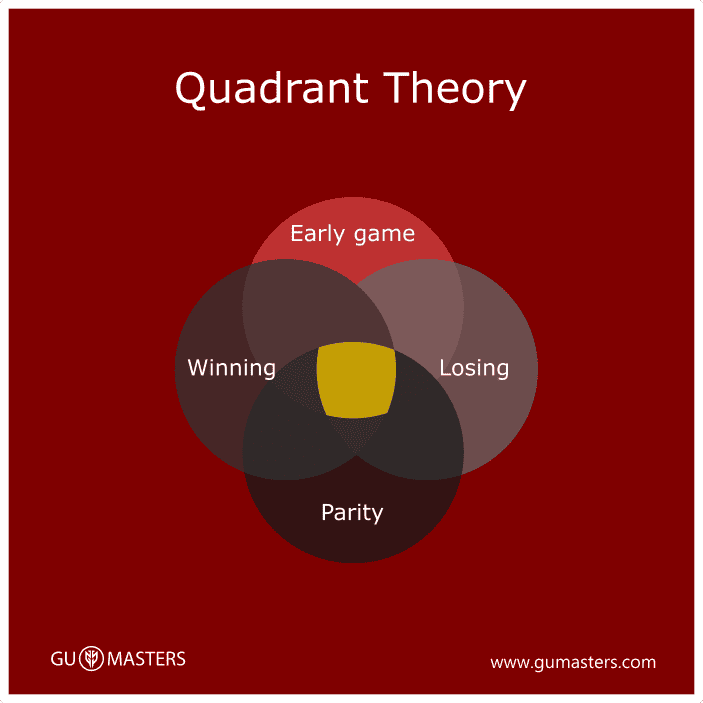
The most powerful cards stand out because they are useful in all or almost all of these scenarios. In a game like Gods Unchained, more oriented to Tempo that a Value , many of the most valued cards do the double function of giving advantage in both dimensions at the same time. We will see examples shortly, but first I invite you to analyze this one. graphical representation of Quadrant Theory . As you can see, there is a central intersection area that alludes to that ideal "sweet spot":
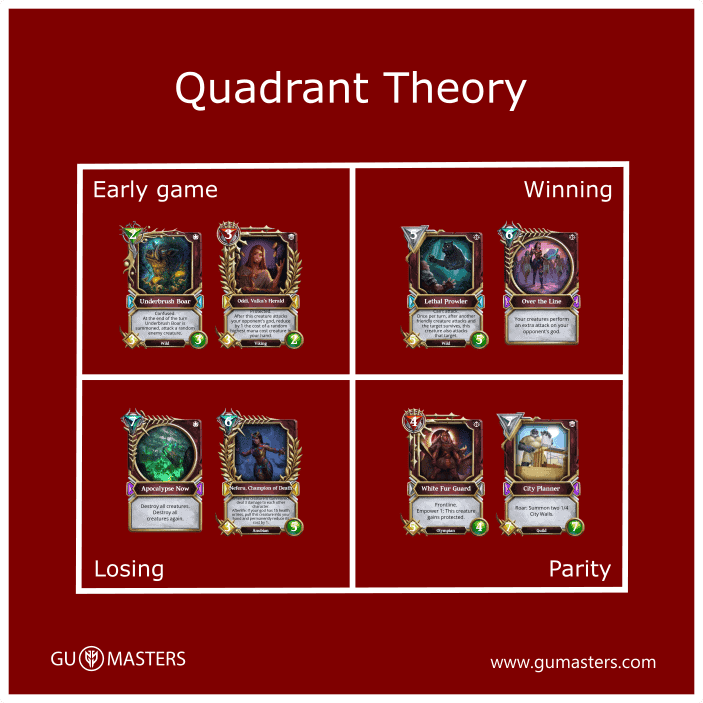
And here's a Graphical representation of the four quadrants mentioned , including some example letters in each of them.
Finally, here you go Four Sample Letters which allow us to visually appreciate what has been exposed up to this point. They have been rated from 1 to 4, considering their usefulness in each of the four scenarios considered, and the resulting graphs are almost self-explanatory:


We said before that in a game like Gods Unchained there are numerous cards that stand out because they have a very strong impact both in terms of Tempo as of Value , being useful in all or almost all quadrants. Cards like Avatar of Deception; Blade of Whiteplain; CERN; Demogorgon; Hortuk; Neferu; Overseer of Vitality; all of them meet this requirement. Let's say that "they are almost always good", at least once the initial turns of the game have been overcome.
Let's think about Demogorgon, as a paradigmatic case . In general, it will allow you to gain an advantage in terms of:
- Tempo , as your opponent loses a turn (their creatures are asleep) and, as a result, you regain the initiative .
- Value , since You're going to heal immediately (for a maximum of three health points) by inflicting damage simultaneously (for the same amount), posing a threat (Creature on the board with 4/6 stats). And, in addition, activating possible synergies, both tribal (it is a Nether) and with another Demogorgon (which puts the board back to sleep, inflict damage and heal).
Note on the Theory of Synergies.- Although I am not going to go into this in depth, I want to mention that there are even more advanced approaches to Quadrant Theory, which integrate synergies into the equation by taking into account the win percentages depending on whether a particular card is drawn throughout the game (or not). If you want to go deeper into this, you can do so using Pawel Sierocinski's article recommended below.
Context
Context matters . It matters, and a lot. Let's take a look.
Synergies and Power-realms
I'm sure you remember that in the "Key Ideas" section we highlighted that the design of the different domains of Gods Unchained is asymmetrical because each god has its "specialties", right? I often refer to this as "Kingdoms of Power" ( Power Realms ), appealing to the principle that Different domains must have the ability to counteract each other .
As I know that this is somewhat abstract, here I leave you Three examples so that you can see it clearly:
- Sleep .- If a domain has access to letters that, on a one-off basis, apply Sleep , nothing happens, it is perfectly acceptable because the chances of it being oppressive are minimal. However, when there is a high prevalence of this effect and the other domains do not have solutions to counteract it, a conflicting asymmetry will be generated. In other words, the Sleep Not a problem per se , but the Permasleep it can be when access to appropriate countermeasures is insufficient. The result? Problematic imbalances in the metagame.
- Ramp The accelerated unlocking of mana crystals is another good example. This is a very powerful effect, only within the reach of some domains. However, if activating them is too simple, it may make sense for other domains to have access to countermeasures (in this case, mana lock).
- Interaction with the Void .- Does a domain have the ability to interact with the Void ? So it makes sense that the other domains have the possibility of limiting or conditioning this in some way (such as by removing cards from the Void or penalizing this type of interaction).
In view of the above, you surely understand that Trying to analyze a card in a vacuum doesn't make sense some. That is, a card exists within the framework of a "Kingdom of Power" (dominance) and a specific goal, which is derived from the available card pool and the game mechanics in force (e.g. Favor/Sanctum).
A very common mistake is to limit oneself to analyzing a card by limiting oneself to assessing its impact on the current meta and thus ignoring its potential impact on future goals. One of the great challenges in the design of this type of game is knowing how to anticipate cards that are not problematic now, but may be in the future (either because they will limit the design space or because, in the worst case, they will cause significant imbalances when combined with new cards). This is usually alluded to with the concept future-proof , that is, it is vital to anticipate possible future interactions.
When the Band of the Wolf mini-expansion was released, Yawgmoth, a professional player who was responsible for the balance of the Gods Unchained metagame for a while, drew up a tier list of his cards in which he contemplated, in separate columns, both its immediate and future impact . In the final version he chose to prepare a power rating of Band of the Wolf cards in which he included comments and possible trends (I share this with your permission, which I want to thank).
By the way, your ability to Spot opportunities in the market It will largely depend on your ability to identify synergies between new cards and existing cards, or between existing cards and future cards. Examples? There we have Parthene Guardian in the Olympians decks (Light and War, since it is a neutral card), a card that was underrated for a long time, or Priestess of Takhat in the Heirloom Death decks, another card that was totally irrelevant until the circumstances were right for it to shine.
Combos
In line with the previous section, in which I mention Bitter Endings, I must bring up A specific aspect related to synergies: the "combos" .
There are cards that are extremely powerful when certain conditions are met and are in a deck designed to get the most out of them. This is the case of cards such as Lost in the Depths, Faustian Pact or Necronomics. They're what I call "Enabling Letters" (or enabling, if you prefer), as they enable the activation of specific interactions. Combo decks are the ones that allow you to squeeze the most out of the possibilities offered by cards like these.
In case you're not entirely sure What does "combo" mean , I clarify: it is considered "combo" the fact of playing several cards following a certain order with the purpose of obtaining results that would not be possible otherwise. For example, playing War, equipping a relic and then playing Whestone and Unrestrained Power, in this order.
As a curiosity, it should be mentioned that there are especially powerful combos that allow you to end the game immediately. They are usually referred to as "One Turn Kills" ("OTK" for friends) and an example is Arcane Burst and then two copies of Pyrrhic Knowledge, the cost of which will have been previously reduced, to deal 30 damage in a single turn.
Game Modes
We said before that simply valuing cards in a vacuum is not enough, because the power level of a card is relative depending on the rest of the existing cards. But not only that. The available gameplay mechanics also influence this, which is why a card can be weak in one context and magnificent in another. And the different Game Modes are the result of combining, to a large extent, all of the above.
By example , Guild Enforcer had the ability to condition the meta for a long time. Specifically, until the release of Light's Verdict and the emergence of Blade of Whiteplain. However, what happens when we take Blade of Whiteplain out of the equation? Obviously, Guild Enforcer is back in the spotlight, as it is in the game mode Pauper .
As you can see, taking into account the different game modes available is More than recommended when valuing a card.
User Profile
The profile of the player to whom a card is addressed (i.e. the type of player for whom it was designed) and who will use it is also relevant. What does this mean? what it means is that There are cards that can be "bad" in the hands of an inexperienced player and very good if used by an advanced player . An example? There you have a card like Bitter Endings, which an expert player will know how to get much more out of than a novice. As a result, two players may value a card in very different ways and, interestingly, both be correct for their respective particular cases.
Key Questions to Identify Letters That Deserve Attention
Next, Three questions that always make sense to ask :
- Is this letter fits into one of the existing decks ? Does it strengthen any specific decks? Will it shine when cards are released that empower certain archetypes?
- Does this card have the ability to give wings to some archetype that someone else has been keeping at bay? That is, can this letter alleviate a specific deficiency and thus become the missing piece in the puzzle for an archetype to regain its splendor?
- Can a new archetype ride on the back of this card? This happens because there are cards that have the ability to put new archetypes on the map, on their own. An example? The combination of Necroscepter and Cursed Obelisk makes Zombies decks viable. We could consider these cards "franchise cards", establishing a parallelism with the "franchise players" of sports teams: their impact is so great that there are decks that are built around them.
The truth is that to identify the best cards there is no choice but to "separate the wheat from the chaff", as the saying goes. It makes sense, therefore, that Let us now devote a few lines to the "bad cards" .
Bad cards?
There are designers and players who consider that the Substandard Cards They are useful as "learning elements". In other words, they are used for new players to learn to distinguish good and bad cards. I do not share this criterion.
From my point of view, it is only admissible that the Starter Deck Cards have a clearly lower than average level of power because, ultimately, they are supposed to allow a new player to become familiar with the game and then expand their collection of cards with the aim of improving their decks.
In my opinion, the approach that makes sense is that there are cards that may not stand out at a specific time, perhaps at the time of their release, but they should have the potential to prove valuable in the future . That's the key, for me, and there's a powerful reason to defend this position: no one likes to buy an envelope and come across cards that are pure filler. Therefore, card game designers should avoid this scenario (at least if they aspire to have satisfied customers).
I am not going to expand on this, but I include several Links with content on this problem:
- "When Cards Go Bad" by Mark Rosewater.
- "Why Blizzard gives new Hearthstone players bad cards" by John Bedford.
Two videos by Kripparrian:
Recommended Articles
Related articles With the topic at hand, for your enjoyment:
- "Pro Player's Guide to Evaluating New Cards" at AQUA.
- "Quadrant Theory Revisited" by Pawel Sierocinski on ChannelFireball.
- "Evaluating cards" on the Gods Unchained blog.
- "The Balance Charter" on the Gods Unchained blog.
To conclude...
As you know, throughout this article we have focused on concepts fundamental such as the following:
- Premises.
- "Vanilla Test" and Mana Efficiency Ratio.
- Value Ranges.
- Quadrant Theory.
- Context (Synergies and "Realms of Power", combos, game modes and user profile).
- Key questions.
- Bad cards?
I trust that you have more resources now than before to assess the power level of Gods Unchained cards and understand the decisions that are made to keep the meta in balance.
The truth is that there are some common mistakes that we should avoid, such as limiting ourselves to thinking in the short term (the cards should be as future-proof as possible, remember?), not paying enough attention to synergies or getting carried away by personal biases (which we all have, but it is necessary to try to minimize). To evaluate cards, it is essential to have a very deep knowledge of the different interactions that exist and to have the ability to foresee possible future interactions , because all the elements that make up a trading card game make up a complex system.
Naturally, applying all of the above will make it easier for you to identify cards with potential. In addition, you can always draw on third-party expertise, as it is common for high-level players to share their ratings. Always cautiously, I do these types of exercises myself and share them with the GU Masters community. So much so, that in the following section of the GU Masters website you will find my personal selection of essential cards in the various expansions of Gods Unchained.
I hope you found this information helpful. I want to take this opportunity to remind you that you can support GU Masters by purchasing your cards through the TokenTrove referral link (which has no cost for you) and invite you to join all the players who already receive the GU Masters newsletter to stay on top of what's new in the Gods Unchained universe: The Herald .
Images courtesy of Gods Unchained Pty Ltd.
- About the author
- Recent articles by the author

I'm the driving force behind GU Masters and my goal is to provide you with the resources you need to improve your skills and achieve your goals in the Gods Unchained universe. Do you already follow me on Twitch and YouTube?